
What review text can reveal that a star rating cannot
More than half of Dubai businesses with 100+ Google ratings score between 4.3 and 4.8. Here is what the star rating hides, and how AI-powered local search surfaces it.
The 4.6 problem
Dubai is not short of reviews. More than 33,000 businesses in the city have at least 100 Google ratings, and over 10,000 have 500 or more. Most of the popular ones end up with almost the same number: more than half (52%) of businesses with 100+ ratings score between 4.3 and 4.8.
Once everyone is a 4.6, the score can't help you choose between the hundreds of options at that score. The 4.6 tells you that people were happy, but not what they were happy about, or what went wrong for the unhappy ones. You don't know the specifics well enough to know if it's right for you. It cannot tell you that the terrace is the best seat, whether parking is easy in the evening, or that portions are big enough to share.
The thing is, the information exists. It's in the reviews somewhere, spread across hundreds or thousands of review writeups that few people have time to read.
Same score, different visit
Joe's Café Dubai and Social House both look out over the Dubai Fountain. Both are rated 4.9, Joe's from 25,425 Google ratings and Social House from 16,591. Both have fountain views, and reviewers at both mention high prices.
Beyond that, the reviews describe different visits. At Social House, the recurring practical concern is service: some guests describe a 20-minute wait for drinks, trouble getting attention and dishes arriving at different times. At Joe's, the concern is food: one diner found the chicken dishes dry and underwhelming.
The tips differ too. Joe's reviewers say to reserve well ahead, especially for the terrace in the evening. At Social House, one guest walked in at 6pm on a Sunday and got a fountain-view table with no wait.
On the score alone the two look interchangeable. Read the text and the choice depends on what matters to you: getting a table, speed of service, or the food.
None of that is visible at a glance, though. Those few lines are scattered across thousands of reviews, and some were raised by just one or two people. Finding them by hand means reading hundreds of reviews for each place, and almost nobody does. It doesn't help that those needles sit in a haystack of reviews like "Great place!", "Loved it" and "Will come again". Reviews like that say almost nothing, and they make the few that matter even harder to find.
What a rating leaves out
Review text holds the details that decide a visit: what a place does especially well, what tends to go wrong, who it suits, what to ask for, and the small surprises nobody puts on a menu.
How AI-powered local search reads the text
A new generation of AI-powered local search does that reading for you. Instead of a score and a wall of reviews, it pulls out the points customers keep making, each one tied back to what reviewers actually wrote.
Here is what that looks like for Bosporus Turkish Cuisine at The Beach, JBR, a restaurant with more than 25,000 Google ratings:
- The good stuff: the terrace looks over the sea, the beach and Ain Dubai. Breakfast is the big draw, especially the Sultan Breakfast spread of breads, cheeses, eggs and traditional sides.
- Common concerns: service can be inconsistent, with long waits before ordering, little follow-up during the meal and delays with tea.
- Tips: ask for the second-floor terrace for the views; it's also where people can smoke shisha. Portions are often big enough to share, so check before ordering several mains.
- Small surprises: a few outdoor diners mention crows approaching the tables.
The difference with pure reviews like Google Maps is the highlights are surfaced for you, based on a complete 360 degree view of the restaurant, having read all the reviews, and given the user just what they need to know before they go. That takes a minute to read, and none of it is in the star rating.
At DXB Local, this is how every business page is built:
- Start from relevant reviews. Reviews with something to say, not just the newest or the most extreme.
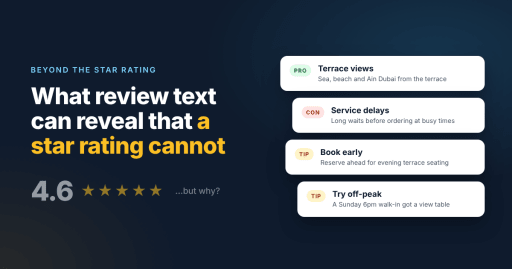
- Pull out three kinds of points. Pros are the positives customers agree on, like Bosporus's terrace views. Cons are the concerns that recur, like its patchy service. Tips are the advice reviewers pass on, like asking for the second-floor terrace.
- Every point needs evidence. The service concern is published because reviewers describe long waits before ordering and slow tea. Without that customer text behind it, it wouldn't appear.
- Cut the noise. "Amazing place!" tells you nothing, so it goes. "Ask for the second-floor terrace" tells you what to do, so it stays.
Run the same process on Joe's Café and Social House and the 4.9 tie breaks open. Joe's page flags *High prices* (one reviewer's 42 AED Americano) and gives two tips: *Book early* for the terrace, and reserve after 6:30pm if you want the evening lights. Social House flags *Service delays* (a 20-minute wait for drinks) and suggests *Try off-peak*: a Sunday 6pm walk-in got a fountain-view table with no wait. Same score, two different evenings, each set out in a few lines.
So far DXB Local has published over 350,000 of these highlights across almost 1,500 business categories in Dubai. For the full detail, here is how DXB Local turns reviews into Pros, Cons and Tips.
What businesses can take from their own reviews
The same reading works from the other side of the counter. For a Gulf business owner, review text is free, continuous customer research.
- Treat recurring Cons as an operations report. One complaint about a slow order is noise. The same complaint across months of reviews is a staffing or process issue, and it is usually fixable.
- Look for patterns, not outliers. Group comments by theme (service speed, booking, parking, value) and see which ones keep coming back.
- Promote what customers already praise. If reviewers keep naming a dish, a seat or a staff habit, that is your marketing message, written by your customers.
- Reply to the theme, not just the review. Saying publicly that you have added staff at weekend breakfast answers every future reader, not only the person who complained.
A business can hold a 4.6 for years while one avoidable issue quietly costs it repeat visits.
From ratings to reviews to highlights
Local search has moved in three steps. First came the rating: one number, easy to compare, hard to act on. Then came the reviews: everything you might want to know, buried in more text than anyone can read. Now come highlights: the specific facts behind the score, pulled out and checked against what customers actually wrote.
The number still matters. But it's the facts behind that star rating that decide whether a place is right for you. With AI-powered local search, finding those needles in the haystack just got a lot easier.
*Bob Chandra is the founder of DXB Local, a Dubai local search engine which turns customer reviews into bite-sized Pros, Cons and Tips about local businesses. He writes about local discovery, review data and practical uses of AI.*